Start with contrasts
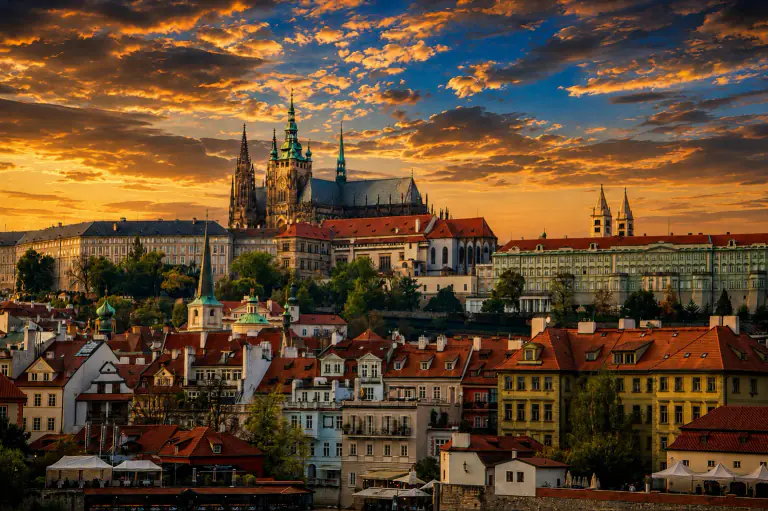
St. George’s Basilica offers a Romanesque interior behind a Baroque façade. At the Cathedral, the medieval eastern chapels contrast with the later west front. In Vladislav Hall, Late Gothic vaulting meets Renaissance window forms. These are not exceptions: overlapping periods are the key to the Castle’s architecture.
A royal residence keeps changing
Charles IV enlarged the palace in the fourteenth century. Rudolf II later made Prague an imperial centre of collecting. The eighteenth-century rebuilding under Maria Theresa brought greater visual unity to the palace fronts, without erasing all the older structures behind them.
A republican chapter
After the creation of Czechoslovakia in 1918, the Castle became a presidential seat. Jože Plečnik’s interventions introduced a modern architectural language into courtyards and gardens. The twentieth century also completed the Cathedral, in 1929.
Three questions for a visit
Ask when a space was built, what it was used for and what later generations changed. A façade may be younger than the room behind it. A ceremonial hall may have served several very different purposes. Reading those differences turns a succession of impressive rooms into a history of how the Castle worked.