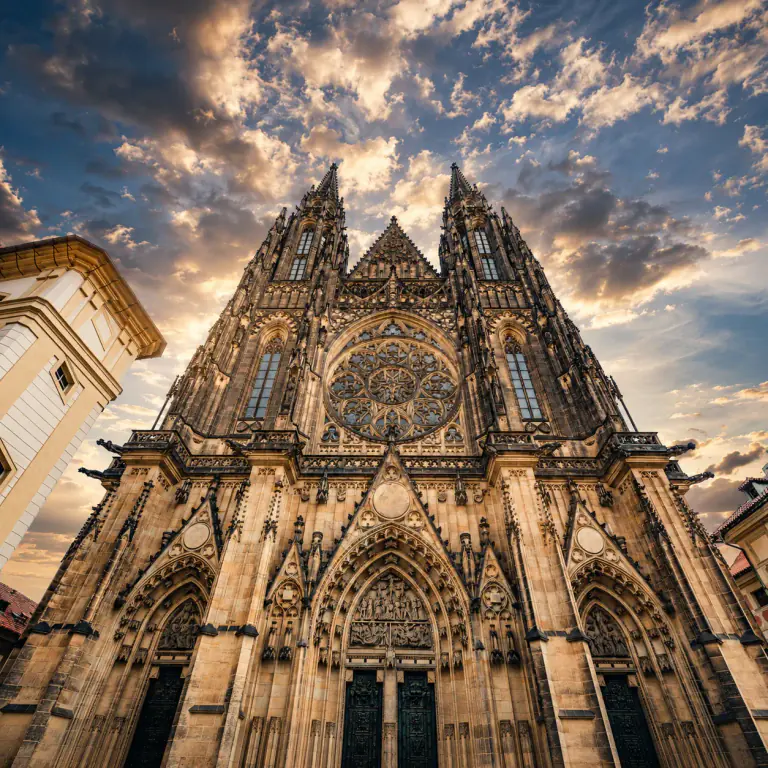
A project begun in 1344
Today’s Cathedral followed a tenth-century rotunda founded by Prince Wenceslas and a larger Romanesque basilica begun in 1060. The Gothic Cathedral was founded in the year Prague became an archbishopric: King John of Luxembourg laid the foundation stone on 21 November 1344, with his son Charles, the future Charles IV, present. Matthias of Arras and Peter Parler led the first great stages of construction.
A much later west front
Work was interrupted by the Hussite upheavals in 1419, and the church was still unfinished after the medieval building campaign. Its completion in 1929 means that the façade facing today’s arriving visitors is not the same age as the eastern chapels. Comparing the two ends is a useful way to understand the Cathedral before entering.
Architecture with a continuing purpose
Coronations and royal burials gave the Cathedral a political role alongside worship. St. Wenceslas Chapel and the royal burial places remain central to understanding that relationship between faith and rule.
What to look for inside
St. Wenceslas Chapel contains the patron saint’s tomb and fourteenth-century decoration incorporating polished stones. Nearby, royal burials connect the church to the history of Bohemian rule. In the later part of the building, stained glass by artists including Alfons Mucha and Max Švabinský brings a different artistic language into the Gothic framework.
Read the building in layers
Begin with the overall space, then choose a chapel, window or sculptural detail to examine closely. Comparing the east and west ends makes the long construction history easier to understand than treating the whole interior as the work of one period. The Cathedral remains a place of worship; visitor access must accommodate services.
Continue the story
For a closer look at details inside the Cathedral, explore Cathedral Mysteries, including the Golden Gate mosaic and surviving medieval window tracery.